
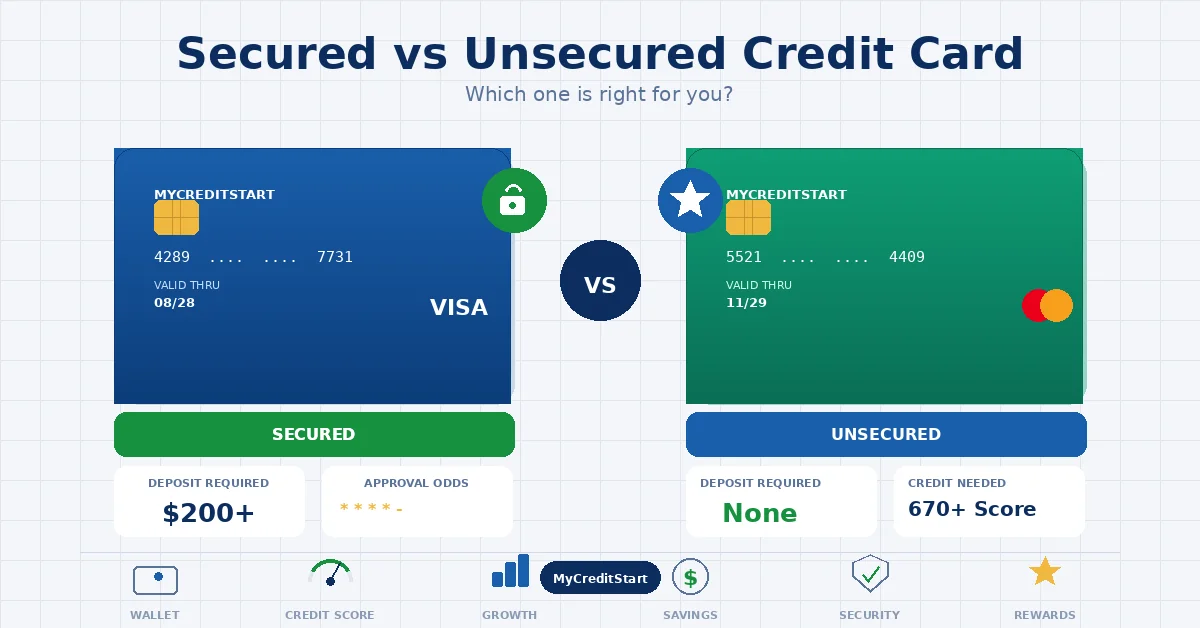
If you’re new to credit in the United States, choosing between a secured and an unsecured credit card is one of the first real decisions you’ll face — and it can feel confusing. The short answer: if you have no credit history or poor credit, a secured card is almost always the smarter starting point. But understanding why — and knowing when an unsecured card might be the better fit — will help you make the right call for your situation.
Building credit in the US isn’t just about getting any card. It’s about choosing the right card at the right time. Let’s break down everything you need to know about secured vs. unsecured credit cards so you can move forward with confidence.
What Is a Secured Credit Card?
A secured credit card works just like a regular credit card — you use it to make purchases, receive a monthly statement, and pay your balance. The key difference is that you must put down a cash deposit upfront when you open the account.
This deposit acts as collateral and typically becomes your credit limit. For example, if you deposit $300, your credit limit is usually $300. If you deposit $500, your limit is $500. Some issuers offer slightly higher credit limits than the deposit, but this is less common.
The reason issuers require this deposit is simple: you are considered a higher-risk borrower. Maybe you have no credit history at all, or maybe you had some credit problems in the past. The deposit protects the card issuer in case you don’t pay your bill. It does NOT mean you can spend freely — your deposit is not a pool of money you draw from. You still receive a monthly bill and must pay it just like any other credit card.
Most secured cards report your payment history to all three major credit bureaus — Equifax, Experian, and TransUnion — which is exactly what you need to build a credit score.
How Secured Cards Work Step by Step
- You apply and are approved (approval rates are much higher than unsecured cards)
- You pay a refundable security deposit — usually between $200 and $500
- You receive a card with a credit limit equal to (or sometimes slightly above) your deposit
- You use the card for small purchases each month
- You pay the balance on time, in full or at least the minimum
- The issuer reports your activity to the credit bureaus
- Over time (typically 6–18 months), your credit score improves
- You either upgrade to an unsecured card or get your deposit refunded when you graduate
Your deposit is held in a separate account and is fully refundable as long as you close the account in good standing or upgrade to an unsecured product.
What Is an Unsecured Credit Card?
An unsecured credit card does not require a deposit. The credit card issuer extends you a line of credit based on your creditworthiness — meaning your credit score, income, and credit history are evaluated, and you are approved or denied based on that information.
This is the type of card most people think of when they picture a “regular” credit card. The vast majority of credit cards on the market — rewards cards, travel cards, cashback cards — are unsecured.
Because there is no deposit protecting the issuer, unsecured cards carry more risk for the lender and typically require at least some credit history for approval. Applicants with no credit history or a low credit score are frequently denied unsecured cards from major banks.
That said, there are unsecured cards specifically designed for people with limited or no credit. These are sometimes called “starter cards” or “credit-building cards.” They tend to have lower credit limits and may charge higher interest rates or fees, but they don’t require a deposit.
Secured vs. Unsecured Credit Card: Side-by-Side Comparison
| Feature | Secured Credit Card | Unsecured Credit Card |
|---|---|---|
| Security deposit required | Yes (usually $200–$500) | No |
| Credit history needed | No (great for beginners) | Usually yes |
| Approval difficulty | Easy to get approved | Harder without credit history |
| Credit limit | Equal to your deposit | Based on creditworthiness |
| Reports to credit bureaus | Yes (with most issuers) | Yes |
| Annual fees | Some charge fees, some don’t | Varies widely |
| Interest rate (APR) | Typically higher | Varies (can be lower with good credit) |
| Upgrade path | Many offer graduation to unsecured | N/A |
| Deposit refundable | Yes | N/A |
| Good for building credit | Yes, very effective | Yes, if approved |
| Best for | No credit / rebuilding credit | Established credit / rewards seekers |
The Biggest Differences That Actually Matter
1. Approval Requirements
This is where most beginners run into a wall. Unsecured credit cards from major issuers — Chase, Bank of America, Capital One, Citi — generally want to see a credit history before approving you. If you have never had a credit account in the US, you likely have no credit score at all. That means applying for an unsecured card often results in an instant denial.
Secured cards flip this equation. Because you are putting down collateral, issuers take on very little risk. You can get approved for a secured card with no credit history whatsoever — and in many cases even with a low credit score or past credit problems.
If you are starting from zero, this approval difference alone makes secured cards the practical first choice.
2. The Deposit Question
One of the most common questions about secured cards is: “Do I lose my deposit?” The answer is no — not as long as you keep your account in good standing.
Your deposit is refundable. If you graduate to an unsecured card (which many issuers allow after 6–12 months of responsible use), your deposit is returned to you. If you close the account in good standing, you also get it back. You only lose your deposit if you default — meaning you stop making payments entirely and the issuer uses the deposit to cover what you owe.
For many beginners, putting down $200 to $300 feels uncomfortable. But think of it this way: that $200 deposit could be the investment that builds your credit score from nothing to 700+ within a year, opening doors to apartments, car loans, and better financial products.
3. Credit Limit Size
Secured cards typically have lower credit limits than the best unsecured cards, simply because your limit is tied to your deposit. This is not a problem for building credit — in fact, lower limits with small, consistent purchases and low utilization can work perfectly well for credit building.
The important thing to understand is that your credit utilization ratio — how much of your available credit you’re using — matters a lot for your credit score. Whether your limit is $300 or $3,000, keeping your balance below 30% of the limit (and ideally below 10%) is what matters most.
4. Cost: Fees and Interest Rates
Secured credit cards are not all equal on fees. Some have no annual fee (Discover it® Secured, for example), while others charge $25–$50 per year. A few older or less reputable secured cards charge additional fees on top of that — monthly maintenance fees, account setup fees, and similar charges. Always read the terms carefully.
Unsecured starter cards for people with limited credit can also carry fees and elevated interest rates. In both cases, the best strategy is to pay your balance in full every month, which means interest rate becomes irrelevant.
Common Situations: Which Card Is Right for You?
You Have No Credit History in the US
Best choice: Secured credit card
If you just arrived in the US, recently turned 18, or simply never opened a credit account before, you likely have no credit file with American bureaus. A secured card is the fastest and most reliable way to start building that file. Many secured cards will approve you even if you have no Social Security Number (SSN), accepting an ITIN instead — which is particularly valuable for immigrants.
After 6–12 months of responsible use, you can often upgrade to an unsecured card and have your deposit returned.
You Have Fair Credit (580–669)
Best choice: It depends — compare both options
If you have some credit history and a fair credit score, you may qualify for certain unsecured starter cards. Compare the fees and interest rates between your unsecured options and available secured cards. In some cases, a no-annual-fee secured card may actually be a better deal than a fee-heavy unsecured starter card.
Check whether you are pre-qualified for any unsecured cards (pre-qualification uses a soft inquiry and doesn’t hurt your score) before making a final decision.
You Had Credit Problems in the Past
Best choice: Secured credit card
If you have past late payments, a bankruptcy, a charge-off, or similar negative marks, a secured card is often your most realistic path back. Most secured card applications are approved regardless of past credit issues, as long as you’re not currently in bankruptcy proceedings.
You Want Rewards While Building Credit
Best choice: Secured card with rewards OR an entry-level unsecured rewards card
A handful of secured cards offer cash back on purchases. The Discover it® Secured card, for instance, offers 2% cash back at gas stations and restaurants and 1% on everything else. If you qualify for an unsecured starter card with similar rewards, compare the total cost (including fees and deposit opportunity cost) before deciding.
Can You Build Credit Just as Fast With a Secured Card?
Yes — absolutely. The credit bureaus do not treat secured cards differently from unsecured cards. What matters is the behavior on the account:
- Payment history (35% of your FICO score): Pay on time, every month
- Credit utilization (30%): Keep your balance below 30% of your limit
- Length of credit history (15%): Keep the account open and active
- Credit mix (10%): A credit card adds to your mix
- New inquiries (10%): Limit new applications
A secured card used responsibly will build your credit score just as effectively as an unsecured card. Many people go from no credit score to 700+ within 12–18 months using a single secured card and smart habits.
When to Upgrade From a Secured to an Unsecured Card
Most issuers that offer secured cards will periodically review your account and may offer you an automatic upgrade to an unsecured card. The typical timeline is 6–18 months of responsible use.
Signs you may be ready to upgrade or apply for an unsecured card:
- Your credit score has reached at least 620–650 or higher
- You have 12+ months of on-time payments with no missed payments
- Your credit utilization has consistently stayed below 30%
- You have received a pre-qualification offer from your issuer or another lender
When you graduate, many issuers simply convert your existing account to an unsecured card without requiring you to close the old account. This is ideal because it preserves the age of your credit account — which helps your score.
If your issuer doesn’t offer an automatic graduation path, you can apply for a new unsecured card once your credit is strong enough, then decide whether to close the secured card or keep it open (keeping it open is usually better for your credit score in the short term).
Red Flags to Avoid With Both Card Types
Whether you’re looking at secured or unsecured cards for beginners, watch out for these warning signs:
- Very high annual fees — Some secured cards charge $75–$99+ per year. Look for cards with no annual fee or fees under $35.
- Low initial credit limit due to fees — Some cards charge fees that eat into your credit limit (e.g., $300 limit minus $75 fee = only $225 available). This artificially inflates your utilization.
- No credit bureau reporting — A card that doesn’t report to at least one major bureau is useless for building credit. Always confirm reporting before applying.
- Very high APR without a grace period — While you should aim to pay in full monthly, unexpected situations happen. An extremely high APR (30%+) combined with no grace period is dangerous.
- Monthly maintenance fees — Some cards charge monthly fees on top of annual fees. These add up fast and often signal a predatory product.
Best Secured Cards Worth Considering
Here are some commonly recommended secured cards for beginners (always verify current terms before applying):
- Discover it® Secured Credit Card — No annual fee, earns cash back, automatic review for upgrade after 7 months
- Capital One Platinum Secured Credit Card — Low minimum deposit option ($49, $99, or $200), no annual fee
- Chime Credit Builder Visa® — No credit check required, no minimum security deposit in traditional sense
- OpenSky® Secured Visa® Credit Card — No credit check at all, accepts applicants in most situations
Frequently Asked Questions
Is a secured credit card better for building credit than an unsecured card? Not necessarily better — both types build credit the same way because payment history and credit utilization affect your score regardless of card type. However, secured cards are far easier to get approved for when you have no credit history or poor credit, making them the practical first step for most beginners.
Does a secured credit card hurt your credit score? No. Applying for a secured card results in a hard inquiry (a small, temporary dip of a few points), but responsibly using the card will steadily build your score over time. The short-term dip from the inquiry is worth the long-term gain.
Can I get an unsecured credit card with no credit history? It’s difficult but not impossible. Some issuers — like Capital One, Discover, and a few credit unions — offer unsecured starter cards for people with no credit. However, approval is not guaranteed, and secured cards remain the more reliable path for those starting from zero.
How long before I can upgrade from a secured to an unsecured card? Most issuers review accounts after 6–12 months. If your payment history is clean and your utilization is low, many will offer an automatic upgrade. Some issuers (like Discover) have a formal review process starting at 7 months.
What happens to my deposit when I close or upgrade a secured card? If you upgrade to an unsecured card with the same issuer, your deposit is typically refunded to your original payment method within 2–10 business days. If you close the account in good standing, the same applies. You only forfeit the deposit if you default on your payments.
Can immigrants get a secured credit card without a Social Security Number? Yes, many secured card issuers accept an Individual Taxpayer Identification Number (ITIN) instead of an SSN. Some secured cards (and a few unsecured ones) are specifically designed for immigrants and do not require either. Always check the application requirements before applying.
Related Guides on MyCreditStart
- Secured Credit Cards Explained
- Best Credit Cards to Build Credit
- How to Start Building Credit
- Get Approved for Your First Credit Card
- Credit Utilization Explained
- Best Credit Cards for Beginners With No SSN / ITIN Options
Helpful External Resources
- Consumer Financial Protection Bureau — What is a secured credit card?
- Experian — Secured vs. Unsecured Credit Cards
Conclusion
The secured vs. unsecured credit card debate usually has a clear answer for most beginners: start with a secured card. It’s easier to get, requires no prior credit history, and works just as effectively for building your credit score as an unsecured card does.
Once you’ve used a secured card responsibly for 6–18 months — paying on time, keeping your balance low, and staying patient — your score will grow to a point where the best unsecured cards become available to you. That’s when you can step up, get your deposit back, and access better credit products.
The deposit isn’t a punishment. It’s a tool. Use it well, and it pays dividends far beyond the couple hundred dollars you put in.
About the Author
Aleks Romanov is the founder of MyCreditStart, a website that helps beginners and immigrants understand how credit works in the United States. He writes practical guides about credit scores, credit reports, and building strong credit safely.